
A customer calls about a charge they do not recognize. The question reaches the right team, but the agent needs more information before it can be investigated. The customer provides it, ends the call and waits. When they call back for an update, they have to explain the issue all over again.
Imagine this as one ordinary service journey. From the contact center's point of view, each interaction may have been handled promptly. From the customer's point of view, the problem is still open—and keeping it moving has become their job.
AI can help change that experience. It can make it easier to explain a request, find a relevant answer, complete an authorized service step and give employees useful context when a person needs to take over. But the difference customers notice depends on what happens across the whole journey, not just on how quickly the first conversation starts.
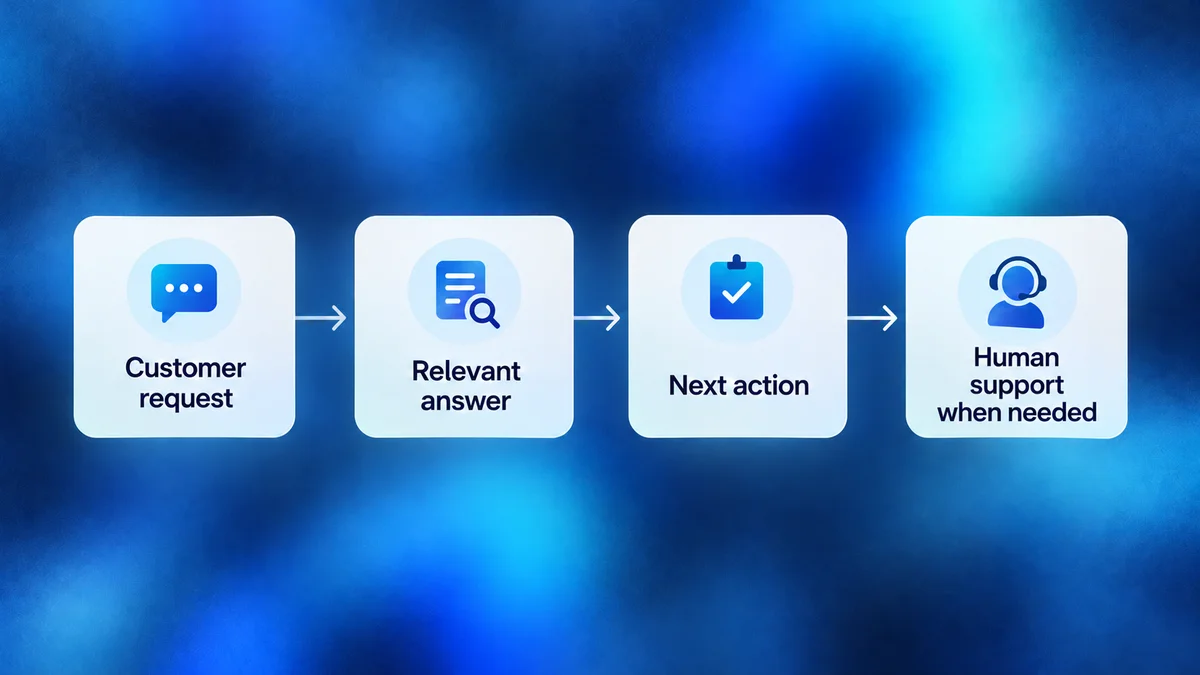
Understand what the customer is trying to do
A customer rarely arrives with a neatly labeled service request. “There’s something wrong with my bill” could mean they do not understand a fee, have spotted a duplicate charge or are concerned that a payment has not appeared. Those questions may belong to different teams and need different responses.
An AI agent can help by listening to the request in everyday language and asking a relevant follow-up question. Instead of choosing from a long menu, the customer can explain the issue in their own words. If the intent remains unclear, the conversation should leave room for clarification or a route to a person.
That first exchange has consequences for everything that follows. If the agent mistakes a disputed charge for a general billing question, a perfectly accurate explanation of billing policy will not help the customer. Getting the request right is what makes the next answer useful.
The same principle applies across channels. A customer may begin in chat and call when their question becomes more complicated. For teams considering AI across voice and digital service, the aim is to make each entry point useful and, where systems allow, retain enough context that a change of channel does not mean starting again.
Give an answer that reflects the customer's situation
Once the request is understood, customers need information they can use. General guidance has a place: an explanation of how billing adjustments work may answer a straightforward question. But if the customer is asking about a particular charge, they need to know what applies to their account.
AI can help find answers in approved service knowledge and explain them clearly. When the organization has authorized access to account or case information, an AI agent can also use that context to provide a more relevant response. The distinction matters: a general policy answer should not be presented as a confirmed account-specific answer.
For example, a service agent could explain the usual investigation process and, after any required identity checks, look up the status of the customer's existing request. If the status is not available, the useful response is to say so and explain how the customer can get an update—not to fill the gap with an assumption.
Employees need reliable information too. When a request reaches a person, an AI Copilot can help them find approved guidance while they check the answer and decide how to respond. This is especially helpful when an agent needs to bring together service rules, product information and the customer's situation during the same conversation.
Help the customer move beyond the answer
Some questions can be resolved with an explanation. Others need a change, an investigation or a follow-up. The customer asking about an unfamiliar charge may need a dispute recorded and a clear explanation of what happens next; a customer asking about an application may need to know which document is missing.
With the appropriate permissions and system connections, an AI agent can carry out routine steps such as retrieving a status or creating a follow-up request. That turns the conversation into something the service team can act on. What the agent can do will depend on the business rules, the systems available and the identity checks required for that task.
There is also a point at which a person should take over. A disputed charge may require investigation; a customer may ask for an exception or want to speak to an employee. In those situations, the AI agent can help by capturing the issue and directing it to the right team, rather than leaving the customer to work out where to go next.
For a service leader, this is a useful way to choose an initial use case. Look for a frequent request with a clear outcome: for example, giving an application update and explaining any outstanding step. A journey like this is easier to assess than a broad ambition to “automate customer service,” because the team can see whether the customer actually received what they needed.
Make AI-to-human handoffs a continuation, not a restart
When a request needs a person, speed still matters—but so does continuity. A customer who has already explained a billing problem should not have to reconstruct the whole conversation for the next employee.
A useful handoff gives the receiving agent the relevant request, information already collected and steps taken so far, within the organization's access and verification rules. The employee can then check the details, ask what is missing and focus on the part that needs human judgment. If no one is immediately available, the customer needs a clear explanation of what will happen next.
A transfer alone does not create that continuity. Our guide to AI-to-human handoff in contact centers looks more closely at the information and ownership needed to make the transition work.
Make customer follow-up count
The end of a call is not always the end of a request. A technical team may still need to investigate a fault, a document may need review, or a customer may want time to consider an offer. In each case, the conversation should leave the next team with enough information to follow up appropriately.
Take renewal outreach. One policyholder may be ready to proceed; another may have a question that needs an employee's attention. Treating both calls as simply “completed” tells the team little about what to do next.
Lifenet Insurance used Dyna.Ai Voice Agent for renewal outreach, capturing customer intent and categorizing conversations for follow-up. The team could use those signals to prioritize its next conversations, while remaining responsible for renewal decisions. The value was in making the outreach useful to the people continuing the work, as well as reaching policyholders.
That same distinction applies to the disputed charge in our opening example. Recording that the customer called is a start. Recording the issue, the investigation requested and how the customer can receive an update gives both the service team and the customer a clearer way forward.
Measure customer experience beyond the first response
Service leaders need to know whether these changes are improving the experience. Fast answers and shorter calls are useful operational signals, but they do not show on their own whether the underlying request was resolved.
Start with the outcome of the journey. For a status inquiry, did the customer receive the correct status and understand any outstanding step? For a dispute, was the issue recorded and investigated, and did the customer receive the promised update? The definition of resolution should reflect the work involved, rather than treating every closed conversation as a solved problem.
Then look for signs of friction across the journey:
- Repeat contact: Do customers return about the same issue? Some follow-ups are a normal part of a longer process; others may reveal that an answer or update fell short.
- Handoff quality: When an employee takes over, do they have enough context to continue? Review a sample of transfers to find where information is missing.
- Customer feedback: Where did the interaction feel unclear or difficult? Feedback can reveal problems even when the operational record looks complete.
Compare similar types of request over a consistent period, and look at service records alongside customer feedback. If outcomes change after introducing AI, investigate the other changes in the process before assigning the result to the technology alone.
Turn more customer conversations into progress
When customers reach out, they want to know that someone understands the issue and that the next step is clear. AI is most useful when it helps deliver that experience consistently, whether the answer comes directly from an AI agent or the conversation continues with an employee.
Dyna.Ai's Customer Service Agent brings approved knowledge and customer context into service conversations and helps route requests to a person when needed. Explore Customer Service Agent to see how your team can give customers clearer answers and keep requests moving.