
The moment a voice AI agent hands a call to a person is often where a smooth customer experience falls apart. If a customer has to repeat their entire story, the conversation effectively starts over from scratch.
That handoff is a critical window for contact center leaders. When the customer’s intent and prior context reach the right agent seamlessly, the conversation picks up right where it left off. The employee can focus entirely on solving the issue—and the customer feels truly heard.
But getting there requires more than just transferring a call. It takes a strategic approach to when a human should step in, what context they need, and how to handle the flow when no agent is immediately available.
When should voice AI hand a conversation to a person?
Some customers simply prefer to speak with an employee. Others may start with a routine question that becomes more complicated: a bill does not match what they expected, a claim needs review, or an account record cannot answer their question.
The right point to involve a person depends on the organisation’s services and policies. A voice agent may be able to explain an account status or take an initial request, while a dispute, complaint or decision requiring judgement goes to a trained employee. If identity cannot be verified or information is missing, the next step should reflect the organisation’s own procedures.
The destination matters as much as the trigger. A billing specialist may be able to resolve a charge that a general service agent would otherwise need to transfer again. But routing every difficult call to a specialist can also send simple requests to a team that is harder to reach. The reason for the handoff helps the organisation choose an appropriate destination and gives the receiving employee a place to start.
Give the next agent a useful starting point
Imagine a telecom customer calls about a charge they do not recognise. The voice agent explains what the billing record shows, but the customer says the charge is incorrect and asks for someone to review it. A handoff that says only “billing question” leaves the employee to rediscover the issue.
A more useful note might say: “Customer disputes a charge on the latest bill. The current billing record was explained, but the customer still wants it reviewed.” The employee can then start with the disputed charge instead of asking the customer to repeat the whole conversation.
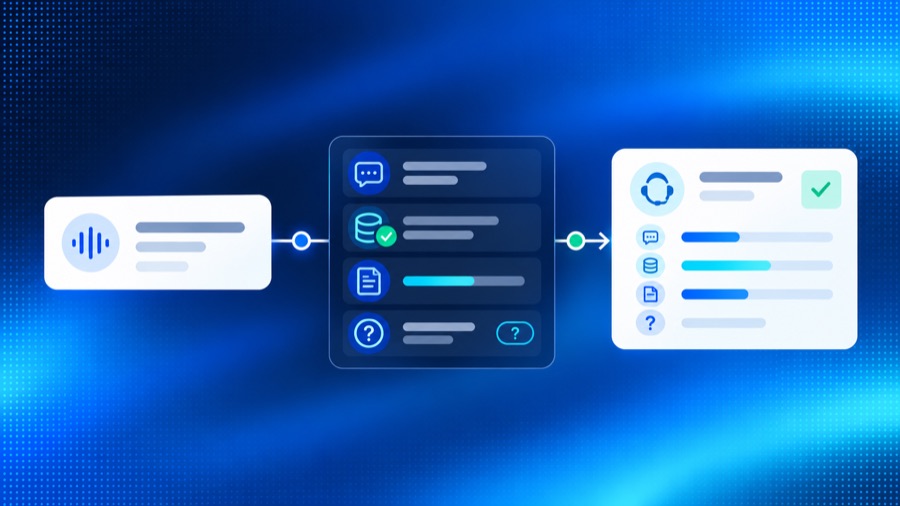
This is an illustrative example, not a product screen. The exact information available depends on the workflow and connected systems. In practice, a useful handoff brings together:
- The customer’s request: what they need help with and why the conversation is being transferred.
- What has already happened: information checked, explanations given and any actions completed or attempted.
- What remains open: the question that still needs an employee’s attention.
- Relevant status and next step: verification or case status where appropriate, and the team or person expected to take it forward.
The summary should distinguish what the customer said from what a system confirmed. In the billing example, “the customer disputes the charge” is different from “the charge was incorrect.” That distinction lets the employee investigate without treating an unverified statement as a resolved fact.
Make the handoff work when nobody is immediately available
A customer may need help when the right team is busy, the queue is closed or the connection fails. That is where the difference between routing a call and handing over a case becomes important.
If a live transfer cannot happen, the customer needs a clear explanation of what happens next. Depending on the organisation’s process, the request might go to another team or be followed up later. A useful fallback names the team responsible, records the outstanding issue and tells the customer what to expect using the service commitments the organisation has actually made. A case sent towards a queue is not necessarily a case that someone has accepted.
Transfer methods also affect the experience. A warm transfer allows the first agent to remain on the line as the next agent joins; a cold transfer routes the customer without that continuity. As Google Cloud’s contact center documentation illustrates, the options depend on the contact center setup. For an AI-to-human handoff, the practical check is whether the employee can see the relevant context when it is needed—not just whether the call connects.
Give employees context they can trust
A useful summary helps an employee orient themselves, but it does not replace the organisation’s records or its processes for checking them. If a customer has requested a review, the employee should be able to tell whether a review has actually been opened. If the conversation includes an identity check, the receiving employee needs to know what was completed and whether it is sufficient for the next action under the organisation’s rules.
More information is not always better. A long transcript can make the important point harder to find, while passing passwords, authentication answers, full payment details or other unnecessary sensitive information creates avoidable exposure. The aim is to give the receiving role the context needed to help, with access and retention governed by the organisation’s policies.
How do you know the handoff is working?
The clearest test is to follow a conversation from the customer’s first request through to the employee’s next action. Can the employee see the issue and earlier steps? Does the customer know what will happen next? If the intended team is unavailable, is someone responsible for following up?
Test more than the straightforward case. Try a missing record, an incomplete verification, a closed queue or a summary that gets an important detail wrong. These situations show whether the employee can recognise uncertainty, check the right source and continue without making an assumption.
After launch, reviewing a sample of transferred conversations alongside their case records can reveal where the handoff breaks down. If the context is accurate but employees cannot find it, the issue may be access or presentation. If it arrives but the next team is unclear, routing or ownership may need attention. If customers still have to repeat key details, compare what was captured with what employees can actually use. A transfer count shows activity; these checks help teams decide what to improve.
Let your team pick up where the conversation left off
When a customer needs a person, Dyna.Ai Voice Agent can route the conversation to an employee with a summary and context captured. Book a demo to see how your team can move from the first conversation to the next step.