
Your service team wants fewer status calls. Collections wants fewer accounts reaching late-stage arrears. Sales wants applications that were started but never finished. Contact-centre managers want new staff handling live calls competently sooner. Each is a plausible place to use AI, but each asks something different of your systems and people.
AI Use Cases in Banking: How to Prioritise Your First AI Use Case
A first AI use case is one narrowly defined piece of work — one customer type, one task, one system of record — whose readiness you can verify before committing budget.
Prioritise AI use cases in banking by comparing business value, access to reliable information, the consequences of a wrong response, and how you will verify success. Start with a defined piece of work that matters to its owner and can be managed with the people and systems available.
That gives you a way to choose between proposals before committing to a product or building a detailed business case.
What makes a good first AI use case in banking?
Define the work narrowly enough to examine it. “Improve customer service” leaves too many decisions open. “Answer application-status inquiries for one lending product after identity verification” identifies a customer, a task and a boundary.
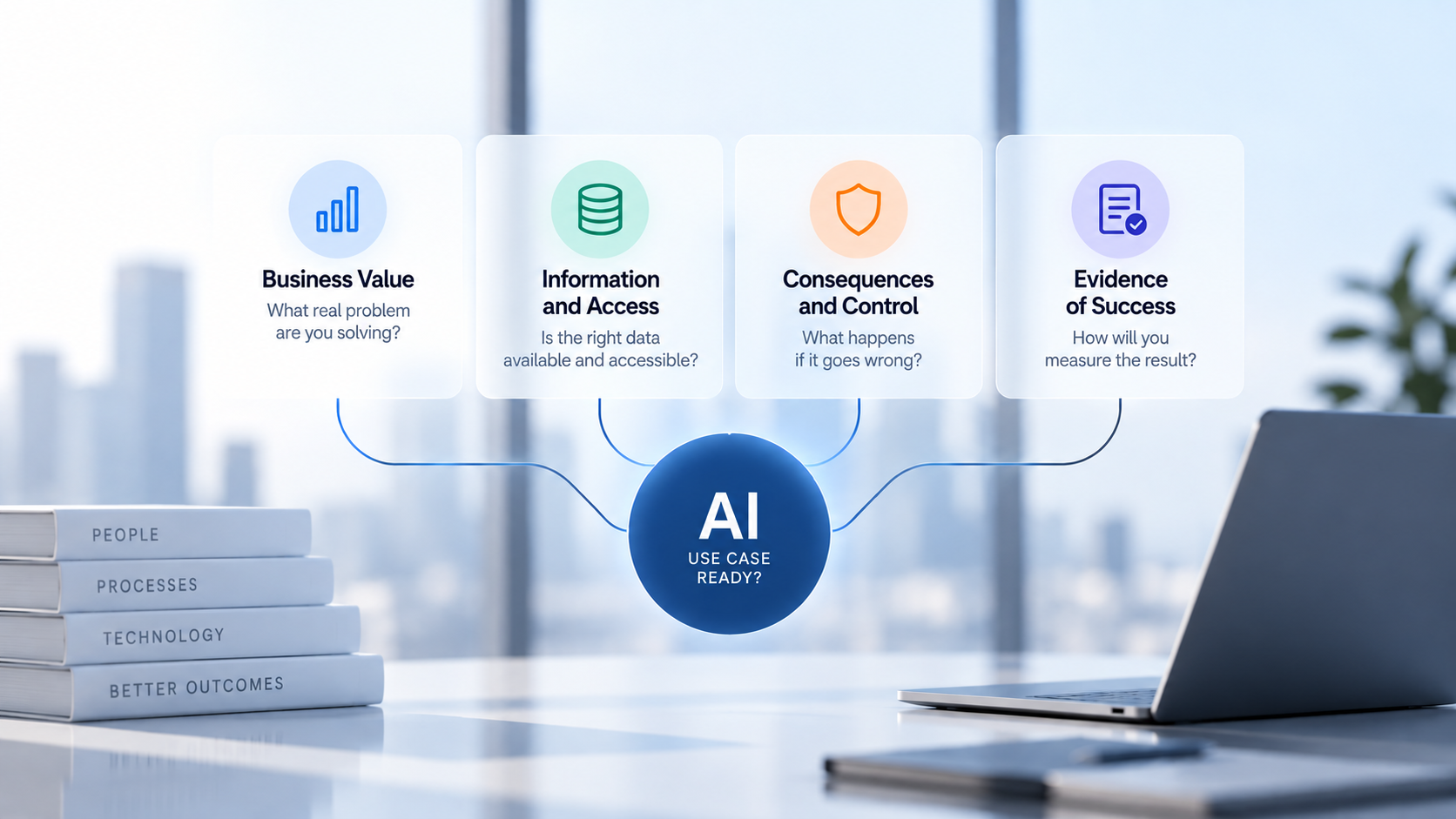
Four readiness checks
- Business value. What delay, repeated effort or missed opportunity would you address? Look at actual requests and staff work rather than estimates. A large call queue may include many different problems, only some of which fit the proposed use case. Measuring the present handling effort is a separate exercise — for telephone work, the banking voice AI ROI guide sets out how to connect operating changes to cost.
- Information and access. Where does the answer come from? Check whether the source is current, whether the system permits the intended access, and who maintains it. A demonstration using sample data does not settle those questions.
- Consequences and control. What could happen if the answer is wrong or an action happens twice? Decide what the AI agent may do, where a person must intervene, and how errors can be corrected.
- Evidence of success. What record would show that the work was completed correctly? For application follow-up, a completed call is less useful than confirmation that the missing document reached the right application.
Check whether AI is needed, too. If a fixed status message or a clearer form would solve the problem, compare that option. An AI agent earns its place where interpreting varied questions, finding relevant information or handling a conversation adds value.
The evidence you define for a use case does more than measure the evaluation. It is also what allows you to ask a vendor to be paid for completed work rather than for access — if you cannot state what a completed piece of work looks like, no commercial model can price it.
Which AI use cases in banking are worth comparing?
The examples below are grouped by the capability they rely on — outbound sales conversations, collections, customer service, and assisting your own staff. Each is written as one narrow piece of work rather than a whole programme: “improve collections” is not a first use case, but “agree a payment arrangement with customers in one early arrears band” is. The examples are illustrative, not customer deployments or a ranking of universally suitable uses. Treat them as a shortlist to prioritise against your own readiness.
| Candidate workflow | Intended outcome | What needs to be ready | Human boundary / reason to defer |
|---|---|---|---|
| Telesales. Contact applicants who started but did not finish one product application | The applicant completes the application, or reaches an adviser who can help | Record of consent to be contacted, current application state, an approved script and the required disclosures | Requests for advice, and any sign of vulnerability, go to a licensed adviser; defer while consent records are incomplete |
| Telesales. Re-engage one defined dormant segment with a specific offer | The customer responds or opts out, and the outcome is recorded against the segment | Verifiable eligibility rules, a suppression list, approved offer terms and an opt-out path | Defer if eligibility depends on information the team cannot confirm at the time of contact |
| Collections. Early arrears: remind and agree a payment arrangement within one defined arrears band | The customer reaches an agreed arrangement or speaks to the right team | Current arrears feed, permitted contact windows and frequency caps, an approved hardship script | Vulnerable customers, disputes and hardship cases go to staff immediately; defer if the arrears feed lags behind collections activity |
| Customer service. Answer application-status and balance inquiries from authenticated customers | An authenticated customer receives the correct current status and next step | Reliable status data, identity checks and approved explanations | Escalate disputed or unclear status; defer if records are stale or inaccessible |
| Customer service. Follow up on missing application or identity documents | The requested document reaches the correct application for review | Accurate missing-item records, an approved contact process and a secure submission route | Staff assess document acceptability and exceptions; defer if completed submissions do not stop reminders |
| AI copilot for employees. Guide contact-centre staff during live calls with sourced policy and next-step suggestions | Staff resolve more first contacts correctly and escalate less | One authoritative policy source, access permissions, and a way for staff to flag incorrect guidance | The member of staff stays accountable for what is said; defer if staff cannot tell which version is authoritative |
The same four checks apply well beyond retail banking. A lender assessing AI for credit and application work, or a contact centre supporting agents during live calls, faces the same questions: where does the answer come from, who receives the exception, and what record shows the work was completed. The workflows differ; the readiness test does not.
Compare the whole task. A status inquiry may involve identity checks and a question about a delay. A document reminder may prompt a customer to explain that they cannot supply the requested item.
An outbound sales call can turn into a complaint, or into a question the agent is not permitted to answer. An early-arrears call may reveal financial difficulty that changes what should be said next. Include those ordinary exceptions when judging the workload — they are where the effort and the risk actually sit.
Where several candidates remain, check what each would need from your systems. Coverage varies: some AI agents for banking handle service conversations end to end, while others stop at routing or drafting. Match that against your own integration capacity rather than against a feature list.
The candidates above are illustrative. To see what a comparable workflow looks like once it is running, Dyna.Ai has published client work on collections efficiency in Singapore and on the features that matter in an AI-powered contact centre.
What should rule an AI use case out for now?
Pause a candidate when the team cannot establish a reliable source, permitted access or an accountable owner. These gaps affect whether the workflow can operate at all; a high estimate of potential value does not resolve them.
“Human review” also needs a practical definition. Name the team receiving exceptions, the information it receives and what happens when nobody is available. Banks that already work to model risk management guidance have a vocabulary for this: the Federal Reserve’s current interagency guidance on model risk management (SR 26-2) sets out expectations for effective challenge, validation and documented ownership that transfer directly to AI agents.
Consider the impact beyond the immediate user. Wrong internal guidance can still affect a customer if an employee relies on it. The NIST AI Risk Management Framework provides a voluntary reference for considering AI risks in their context of use.
Where a candidate touches credit or identity decisions, the EU AI Act classifies some of that work as high-risk and attaches specific obligations. Other regulators have published their own expectations: Indonesia’s OJK issued AI governance guidance for banks in 2025, and Hong Kong’s HKMA has run a GenAI sandbox in which Dyna.Ai has taken part.
Identify which frameworks apply to your licences before the brief is final; a workflow designed against one regime may still need work to satisfy another.
Record a deferred candidate with a specific dependency: “reconsider when application records update reliably,” for example. This preserves the opportunity while making the next step clear.
How do you prioritise two promising AI use cases?
Suppose a bank is comparing early-arrears reminders with application-status inquiries. An arrangement agreed on an overdue account is worth more than a status answer, so the arrears work looks like the obvious first choice. On its own, that is not the deciding factor.
In this illustrative situation, the arrears feed updates daily and the bank has approved contact windows, a frequency cap and a hardship script. The status system, however, cannot expose current application state reliably.
Choose early-arrears reminders for the first evaluation, provided the vulnerable-customer checks and the hardship route are ready. The team can compare each arrangement reached with the account record, and examine whether customers kept to it.
Now reverse the conditions. The bank’s arrears feed lags behind collections activity, so a customer who paid yesterday could still be contacted. The status system, meanwhile, has current records and an approved access route. Application-status inquiries may then be the stronger first candidate, even though each contact is worth less.
The choice follows the bank’s readiness, and value settles the question only when readiness is equal. Where both candidates are ready, compare the burden each removes and the effort each adds: integration, staff review, exception handling and ongoing maintenance. Favour the one with a clearer path to a meaningful improvement within the available budget. The other remains a candidate for later investment.
Which choices look safe but stall?
Three patterns recur in these discussions. None is a reason to reject an idea outright, but each tends to delay a first evaluation by months.
Starting with the most impressive demonstration
A demonstration built on sample data shows what the technology can do, not whether your records support it. Judge the candidate on its source, permissions and owner — the three things a demonstration cannot supply.
Starting with the largest headline number
The use case with the biggest estimated saving usually has the widest scope and the least tidy data. A smaller candidate with a named owner and a current source will produce a result you can act on sooner.
Treating a successful pilot as proof of readiness
A pilot run with manual supervision, a curated data set and the vendor’s engineers present has not yet tested the conditions you will depend on in production. What changes between the two settings is examined in more detail in from pilots to production in banking.
AI use case prioritisation brief: what to include
Capture the choice in a short brief that operations, technology and risk colleagues can challenge. A written brief is what turns a discussion about priorities into a decision someone can be held to. Here is a filled example for the hypothetical status-inquiry workflow:
| Decision | Proposed scope |
|---|---|
| Workflow and user | Application-status inquiries from authenticated customers for one lending product |
| Current problem | Staff repeatedly retrieve and explain information already held in the application system; establish the volume and handling effort from records |
| Intended improvement | Customers receive the correct status and next step with less staff retrieval work |
| Information and permissions | Read approved status fields; no changes to the application or lending decision |
| Exceptions | Failed identity checks, disputed status, complaints and missing records go to the designated service team |
| Evidence to collect | Answer accuracy against source records, customer understanding, repeat inquiries, staff effort and quality of transfers |
| Accountability | Name the service owner and system owner before evaluation; agree who can pause the workflow |
Use a completed brief to expose disagreements early. If one team expects AI to report a status while another expects it to explain a credit decision, the proposed scope is still unsettled.
Writing accountability down also matches the direction regulators have set. The MAS FEAT principles, for example, ask firms to be able to explain how an AI-assisted outcome was reached — which is difficult to reconstruct afterwards if nobody was named as the owner.
Employee-facing vs customer-facing AI in banking: which comes first?
When an employee-facing task comes first
An employee assistant can offer a useful first scope when staff can check the source and correct an answer before acting. It still needs appropriate access restrictions and usable review steps. For a longer view of the transition, see how agentic AI is moving from pilot to production in banking.
When a customer-facing task is ready
A customer-facing task can also be a candidate when it is well defined, supported by reliable information and backed by an available service team. Compare those conditions directly rather than treating the audience alone as a measure of risk.
From AI use case to evaluation: baseline, cost and metrics
Set the baseline before anything is built
Once the choice is clear, establish the baseline and estimate the full cost of delivery — integration, staff review, exception handling and the maintenance that a first evaluation commonly under-budgets.
Compare vendors on your workflow, not their feature list
If more than one vendor can do the work, compare them on the workflow you have selected rather than on feature lists. Ask each to demonstrate the exceptions you listed in your brief; that is where the difference between proposals becomes visible.
Dyna.Ai builds AI agents for banking. Which one is relevant depends on the task you selected: Dyna VoiceGPT for phone-based work such as sales follow-up, early-arrears reminders and service enquiries; an AI knowledge partner where staff need approved guidance during a live call; verification and document handling for identity and application follow-up; and an agent-building environment where your own teams will configure and extend the workflow.
Book a discussion with Dyna.Ai about the workflow you have selected. Bring the task, its source information and the exceptions your team handles today. Those details make it possible to discuss fit, integration and what an evaluation would need to demonstrate.