
Language can shape a customer’s decision to buy. In a 2020 CSA Research survey of 8,709 consumers across 29 countries, 76% of online shoppers preferred to buy products with information in their own language.
Picture this call sequence:
- A customer answers an outbound call about a credit card offer, asking about the annual fee in their local dialect.
- Mid-sentence, they pivot to English to inquire about reward points and cashback tiers.
- Finally, they ask whether a specialist can call them back tomorrow afternoon to finalize the details.
For a sales team, this is more than a completed call. The customer has shown interest, asked specific questions and requested a follow-up.
The opportunity can still be lost if the next person receives only a call outcome. They need to know which card the customer discussed, the questions still to answer and when the customer agreed to speak again.
The Hidden Bottleneck: Where Voice Agents Can Struggle with Code-Switching
Across global markets—from Asia-Pacific and the Middle East to Latin America, Africa, and multilingual Western hubs—customers rarely speak in rigid, single-language scripts. They naturally code-switch: mixing regional dialects, global business terminology, and local expressions in a single breath.
A multilingual human agent can follow these shifts and clarify an unfamiliar term. Some older or single-language voice systems can struggle to do the same, particularly when the conversation needs to continue across languages and teams:
- Single-Language Silos: A system configured for one language may misrecognize a switch or ask the customer to start again.
- Lost Context: A system may recognize individual words but still lose track of which card or policy detail the customer is asking about.
- Incomplete Handoffs: If the conversation details do not reach the next employee, the customer may have to repeat questions they have already asked.
How Modern Voice AI Bridges the Gap Across the Lifecycle
To turn complex conversations into measurable pipeline, enterprise Voice AI must move beyond basic translation and act as an intelligent workflow router.
Here is how Dyna.Ai Voice Agent re-engineers this conversation flow across key enterprise business functions:
1. Sales & Growth: Carry Customer Interest Forward
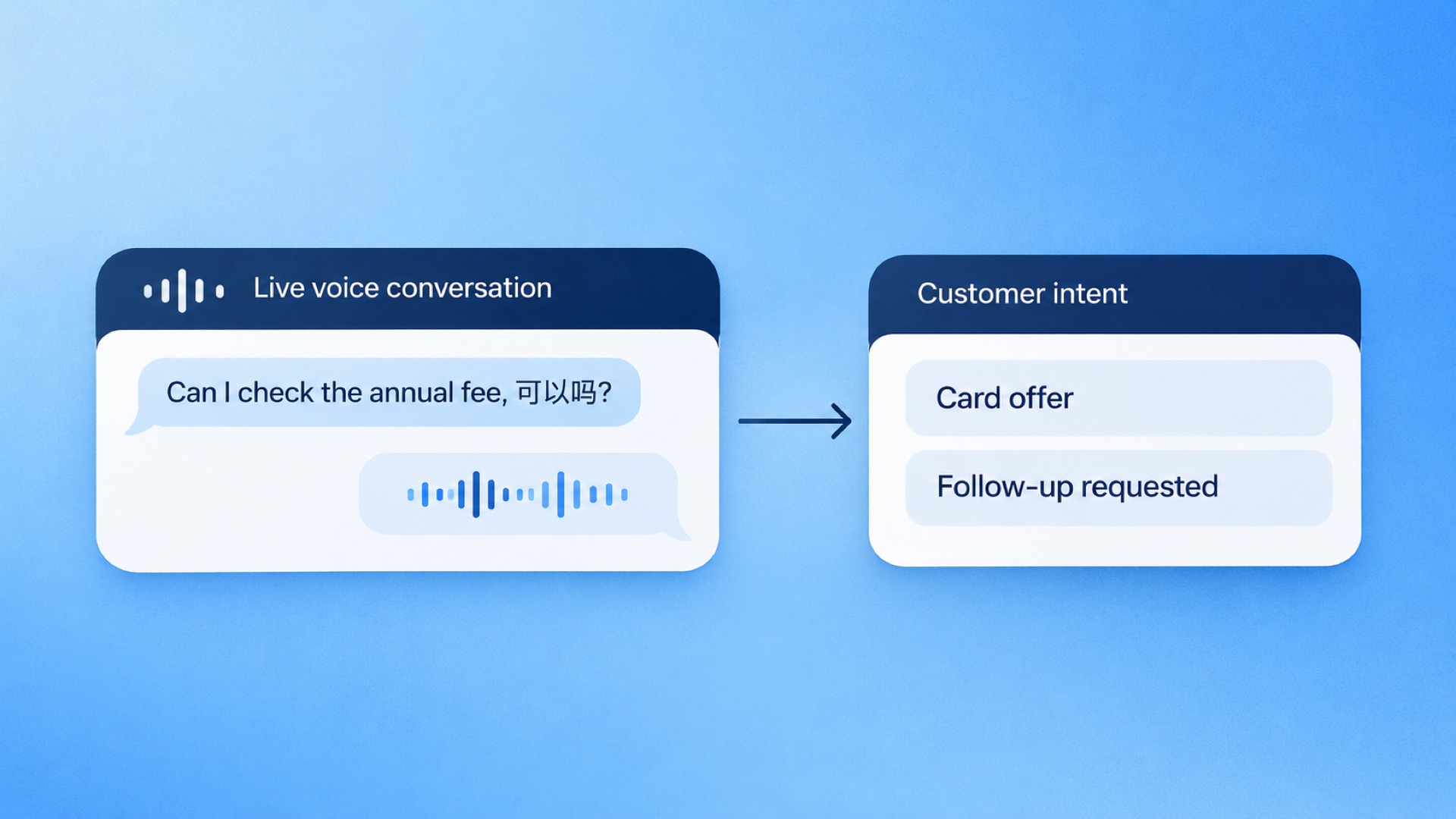
For example, a Voice Agent contacts an eligible customer with an approved card offer. As the customer asks about the annual fee and rewards in different languages, the agent can use approved offer information to respond and capture their interest. Where the workflow and permissions allow, the agreed callback can be recorded in the CRM.
Why Context Matters:
In this illustrative call, the follow-up employee receives the card discussed, the customer’s questions about the annual fee and rewards, and the agreed time: tomorrow afternoon. The offer has not yet been finalized. The employee can continue with those questions instead of starting with a generic pitch.
2. Service & Support: Keep the Request Moving
A customer calling about a billing discrepancy can explain the issue in their own words. Depending on the configured workflow and permissions, the agent can check relevant information, help with an eligible request or route it to a specialist with the context captured so far.
3. Collections & Risk: Clear, Respectful Next Steps
In payment outreach, clear communication matters. The agent can discuss approved options and capture a repayment commitment. Where configured and permitted, the outcome can be passed to the team or system responsible for follow-up.
Proof in Practice: 3× Collections Efficiency
A leading Singapore digital bank connected Dyna.Ai Voice Agents to its existing telephony system for multilingual collections outreach. The Voice Agent handled repeatable first contact and captured conversation outcomes, while bank staff remained responsible for cases requiring judgment or follow-up.
The bank reported 3× collections efficiency and more than 1,000 outbound calls per hour. Its deployment supported conversations across English, Singlish and Mandarin, including code-switching and different accents.
Beyond the Language Count: What Institutional Buyers Must Audit
A list of supported languages is a starting point. The question for buyers is how well the system handles the combinations of languages, accents and business terms their customers actually use.
Look at how the system handles these conversation and workflow challenges:
| Universal Conversational Challenge | The Real-World Execution Risk | What to verify in the workflow |
| Mid-Sentence Code-Switching (e.g., Code-mixing native languages with global business terms) | System loses session state, mistranscribes terms, or forces a language reset. | During one mixed-language call, does the system retain the card discussed, the customer’s questions, their preferred response language and the next permitted action? |
| Dialect & Accent Variations (e.g., Regional speech varieties vs. standardized formal scripts) | Rigid acoustic models fail on natural pronunciation differences or regional syntax. | Can the system extract correct intent despite localized phrasing and non-standard syntax? |
| Contextual Corrections (e.g., "Wait, I meant my secondary account, not my loan") | The agent locks into the first intent detected and ignores mid-call user corrections. | Does the next reply or permitted action use the corrected account? |
| Cross-System Action Triggers (e.g., Syncing intent to enterprise CRMs and Core Banking) | Call insights remain trapped in raw audio logs rather than actionable workflow data. | When configured and permitted, does the outcome reach the right system or owner for follow-up? |
Make Every Customer Conversation Count
Language friction should never stand between a qualified customer and a closed deal.
Dyna.Ai Voice Agent can handle mixed-language conversations, capture customer intent and pass context to the next step. With the right workflow and permissions, sales and service teams can continue the conversation with the information they need.
👉 Book a demo to see how a multilingual customer inquiry can be captured and passed to the next person for follow-up.