
A policyholder calls after a storm damages their home. One AI agent explains how claims generally work. Another collects the reported damage, checks what information is still needed and passes the request to a claims specialist.
Both may sound convincing in a demonstration. But only the second has moved this particular request forward.
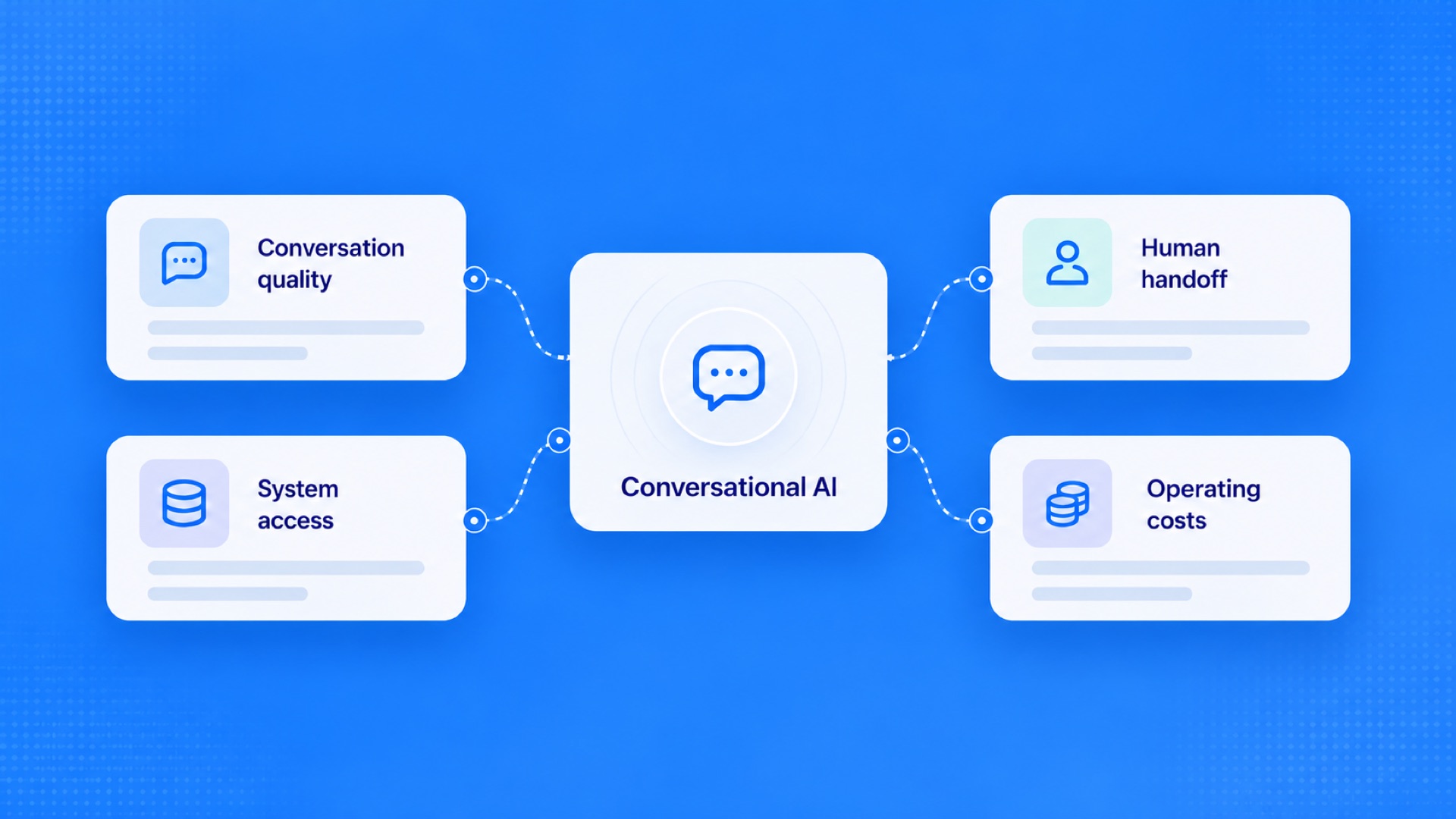
That distinction matters when service, sales and technology leaders choose a conversational AI platform. A fluent conversation is only one part of the decision. The platform also has to use the right information, work with existing systems, protect customer data and give employees a useful handoff when they need to take over. Finance teams need to understand what the complete workflow actually costs.
The strongest comparison follows a real interaction through to its outcome. For an insurer, that might be reporting damage. For a sales team, it could be reaching an interested customer, identifying their needs and arranging a qualified follow-up. For a bank, it might be a repayment conversation. The details and rules differ, but the buying question is the same: can the platform help your organization complete the work, within the boundaries you set?
Start with the outcome, then test the conversation
In the claims example, a useful first outcome might be a complete report delivered to the right team. It is not an automatic coverage decision. That distinction determines what the agent needs to ask, which information it may use and where human judgment belongs.
Give each vendor the same representative request and observe the full journey. Does the agent gather what the specialist needs? Does it understand when the customer corrects a detail? Can it explain what will happen next? For outbound sales, test whether it captures interest or a refusal, respects the campaign rules and routes the appropriate next action. A demo that ends with a good answer may not reveal whether the work reaches its owner.
For a voice AI deployment, test the conversations your customers actually have: different accents and languages, background noise, interruptions and changes of mind. Include a customer who uses more than one language during a call, if that reflects your market. Language coverage on a feature list tells you less than what happens when someone gives an address, corrects it and continues speaking.
Also ask how latency is measured. A single model or speech component may respond quickly while the customer still experiences a pause after finishing a sentence. Compare the full conversational response under representative call conditions and traffic. The right target depends on the workflow; a number without its measurement point is hard to compare.
Dyna.Ai's Voice Agent combines voice models pre-trained for real conversational acoustic conditions with support for mixed-language speech, accents and background noise. Its self-developed inference engine processes speech recognition, language understanding and speech synthesis in parallel, helping keep the conversation moving. For a buyer, the practical test is whether the complete call stays responsive and follows the customer's correction in the conditions your service actually handles. Our multilingual voice AI guide explains the technical choices behind that experience.
Check what the agent knows and how it handles uncertainty
A policyholder may ask whether a particular type of damage is covered. A general explanation is different from a decision on their policy. The agent needs access to approved guidance and a clear way to respond when the answer depends on information or judgment it does not have.
Ask vendors to demonstrate where an answer comes from and what happens when guidance is missing, outdated or contradictory. Who can update the knowledge? How is the change reviewed? What does the agent say when it cannot establish an answer? Test those cases alongside ordinary questions, not just after a satisfactory demonstration.
Retrieval-augmented generation, or RAG, can bring relevant enterprise knowledge into a response. It does not eliminate errors: the wrong document can be retrieved, a source can be outdated, or the response can misrepresent the information. Review the knowledge process, the behavior when confidence is insufficient and the results of testing together.
Agent Studio connects agents with approved policies, procedures and product information, and gives teams a way to evaluate behavior and review knowledge gaps. In the claims journey, that can help an agent explain the reporting process while leaving a coverage decision with the appropriate person.
Look at the action behind the answer
A platform may say it integrates with your CRM or contact-center systems. The practical question is what the agent can actually read, create or update for the workflow you intend to use.
For a damage report, a buyer needs to know where the report is recorded, which fields are required, what identity checks apply and whether the agent can create a case or only pass information to a person. Ask the vendor to show the intended connection and what happens when the system is unavailable, a required detail is missing or the same request is submitted twice.
The answer does not have to be maximum automation. A platform that prepares a complete report for a specialist may be the right choice where an employee must review the claim. What matters is whether the customer and the receiving team can see a clear next step.
Compare the proposed integration as well as the feature: which systems are involved, who builds and maintains each connection, what permissions are required, and how changes in the systems are handled. An API is a starting point, not evidence that a particular connection is ready.
See the human handoff in the receiving system
A transfer is useful only if the receiving employee can continue the work. Ask to see what appears in the specialist's workspace: the customer's request, information already collected, relevant verification status where available, and the outstanding action. Confirm whether a summary, transcript or both are available and whether they reach the tools the employee actually uses.
For the policyholder, that means the specialist starts with the reported damage rather than asking the customer to repeat it. The handoff should distinguish what the customer reported from what has been independently verified. If no specialist is available, test what the customer is told and who owns the follow-up.
Dyna.Ai's Customer Service Agent brings approved knowledge and configured handoff into service conversations. Agent Studio supports role boundaries and workflow controls; One Brain, shared knowledge and relevant memory help connect work across roles and channels. What carries over depends on the connections, access rules and identity checks in the deployment. Our AI-to-human handoff guide looks more closely at the transition.
Ask where data goes and who controls it
A service conversation can contain names, contact details, account information or a description of a sensitive event. Before choosing a platform, the organization needs to understand the full path of that data, including any speech, model, hosting or support providers involved.
Ask where customer data is processed and stored; which parties can access it; whether it is used to train third-party models; and how long recordings, transcripts and logs are retained. Check deletion procedures, access controls, encryption and how the organization can review activity. If a particular jurisdiction or contract places requirements on data location, compare those requirements with the proposed deployment and its actual service scope.
Request the relevant security documentation and contract terms, then check that their entity, services and validity period match the proposed solution. Ask how permissions, escalation rules and human approval are applied in the workflow. No single feature or certificate establishes compliance for every use case; the enterprise and its providers need to understand their respective responsibilities.
Compare models without overlooking the work around them
The language model is one part of a conversational AI platform. A model can affect answer quality, language coverage, latency and cost, but a strong model still needs the right knowledge, permissions, integrations and conversation design.
Model flexibility can be valuable as requirements change. Ask which models are available for the proposed deployment and what happens if one needs to be replaced: which prompts, evaluations, integrations or operating costs change? Run the same representative scenarios before and after a proposed switch. A platform that supports several models does not necessarily make every model interchangeable without further work.
Dyna.Ai's Agent Studio supports the use of different models alongside enterprise knowledge and workflows. The choice should fit the task and deployment, with performance assessed in the customer journey rather than assumed from a model name.
Calculate the cost of a verified outcome
A lower price per conversation is not automatically a lower cost of service. If customers call back, an employee corrects a record or a specialist has to reconstruct the interaction, the work has not disappeared.
For a comparable request type and period, a practical starting point is:
Cost per verified outcome = total in-scope workflow cost ÷ number of outcomes verified.
Include the costs relevant to the comparison: platform usage, model and speech charges where separate, telephony, setup or integration costs allocated to the period, ongoing maintenance and the human work that remains. Include the cost of failed or unresolved attempts and rework in the numerator. Count each outcome once, even if it involved multiple contacts, and track repeat contacts and transfers alongside it. Allocation choices, request complexity and the measurement period affect the result.
For a claim notification, the agreed outcome may be a complete report accepted by the claims team, not a settled claim. For sales outreach, it might be a qualified opportunity with a confirmed next step; for collections, it could be a verified repayment commitment. Define the outcome and its evidence for each workflow, and use the same definition and comparable request mix when assessing alternatives.
Our voice AI ROI guide explains how to separate capacity released from cash savings and account for the costs of a deployment.
Choose for the work your customers need done
The right platform can carry customer work through conversation, business rules, systems and people, whether the goal is resolving a request or progressing an opportunity. It should also give technology, risk and finance teams enough evidence to understand how that work will operate.
Dyna.Ai brings its voice models and streaming engine together with specialized roles for customer service, sales and collections. Shared knowledge, workflow controls and human handoff help those roles move customer conversations toward the right outcome. Explore Agent Studio to see how your team can build and manage agents across customer-facing workflows.