
A customer calls to add a family member to their insurance coverage. The Agent records the request and routes it to a specialist. The handoff is complete, but the specialist still has to establish whether this policy allows the change and what the customer needs to provide.
The customer is waiting for an answer, not a transfer. If the specialist has to piece together the request, search for the relevant guidance and check the policy in separate systems, a smooth first conversation can still lead to a long wait.
A stronger service operation helps the person answering today and the team handling similar requests tomorrow. A customer-facing Agent captures the request, a service Copilot helps the specialist find and use approved guidance, and a QA Copilot helps quality teams review the interaction against their standards. People remain responsible for the policy decision, the response and the coaching that follows.
Three roles around one customer request
A Customer Service Agent engages with the customer. It can answer appropriate questions using approved knowledge, help with permitted service steps and route a request when a person needs to take over. Depending on the workflow, customer contact can begin with an incoming inquiry or an authorized outbound conversation.
Customer Service Copilot assists the employee handling the case. It can bring together available customer context and approved policy or product information, summarize the issue and help prepare a response for review. It does not decide whether a particular customer qualifies for a policy change.
QA Copilot serves the quality team. It helps review interactions against defined criteria, identify issues and prepare guidance. For a configured quality workflow, scoring and identified portions of a conversation can help a reviewer find where a script or service standard may need attention. The reviewer checks the assessment and decides what action to take.
These roles can be used separately. Combining them around a journey depends on the organization’s configured sources, permissions, connections and review processes; a deployment should not be assumed to have automatic end-to-end integration.
Follow a coverage change from the first call
Consider the opening request as an illustrative workflow, not a description of a specific customer deployment.
The customer asks to add a family member to their coverage. The Agent answers a general question from approved guidance and records the requested change. Whether that family member is eligible under this policy remains open, so the Agent routes the request to a specialist rather than presenting a general answer as a policy-specific decision.
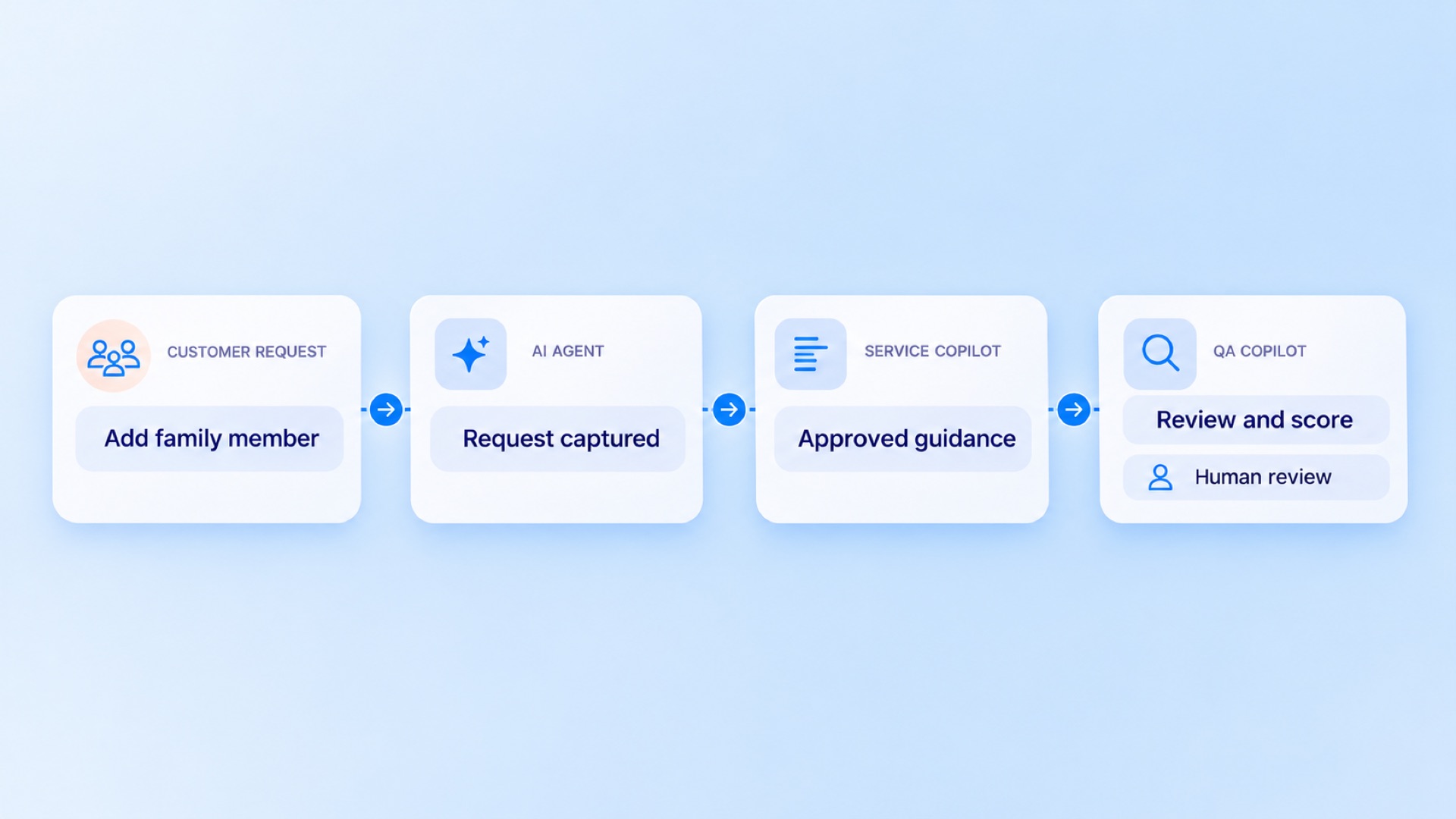
When the workflow is configured to carry context forward, the specialist receives the request and sees that eligibility still needs to be verified. The customer can continue from that point instead of explaining the request again. That helps only if the employee can also find the right guidance and apply it to the policy.
The service Copilot can bring the specialist to approved guidance on who can be added and which documents the process requires, alongside the available case context. It can also prepare a response. The specialist checks the customer’s policy against that guidance and reviews the proposed answer. In this illustrative branch, the specialist identifies the documents needed and explains what the customer should submit and how. The request then moves to review; the customer leaves knowing the next step, without a premature promise that the change is approved.
This is where Agent and Copilot make a practical difference to the employee’s work. The specialist is not starting with an empty case or searching blindly across documents. They can spend more of the interaction checking the policy, resolving the open question and explaining the requirements clearly. The outcome depends on the quality of the sources, the available case context and the employee’s review.
What happens after the conversation?
The next question belongs to the quality team: was the customer given a clear and accurate explanation, and did the conversation follow the organization’s service standards?
QA Copilot addresses that review rather than acting as the specialist’s service assistant. Using the criteria configured for the workflow, it can help quality teams assess conversations, produce scores and point reviewers to issues in the interaction. For the coverage-change call, a reviewer could check whether the specialist explained the documents and next step clearly, then listen to the relevant part of the conversation before deciding whether the assessment is fair.
A supervisor can use the reviewed findings in coaching. If several conversations show the same confusion about required documents, the team can examine whether the knowledge article or call guidance needs to be clearer. That improvement is a human decision: a quality finding does not automatically rewrite policy, change a script or prove the same issue exists across every call.
This gives the team a way to review more than the individual handoff. The Agent helps capture the customer’s request; service Copilot helps the specialist prepare; QA Copilot helps reviewers find and assess patterns. Managers can use that evidence to coach employees and improve the guidance they rely on. New colleagues can benefit from access to the same approved information and reviewed examples rather than relying solely on memory or informal advice.
Where can a service team see the value?
Start with the work that consumes attention after the first question:
- Less repetition for customers: Can the specialist see the request and open issue instead of asking the customer to explain them again?
- Less searching and answer preparation: Can the employee find the relevant approved guidance and prepare a response without piecing it together across several sources?
- More useful quality review: Can reviewers cover more relevant interactions and find the parts that need attention, while retaining time to validate the assessment?
- More consistent team support: Can supervisors use reviewed examples to coach employees and improve the information available to new colleagues?
These are outcomes to assess, not guaranteed results. A shorter first call is less valuable if the customer must call again or the specialist spends longer correcting missing information.
A Hong Kong insurance brokerage used AI Copilot to help advisers retrieve approved policy knowledge and prepare answers. Licensed advisers retained responsibility for decisions. It is evidence of employee support in an insurance workflow; it does not establish that an Agent, service Copilot and QA Copilot were connected in that deployment.
How should teams measure the result?
Follow comparable requests across the whole service journey. For employees, observe time spent finding guidance and completing post-call work. For customers, look at repeat contact and first-contact resolution using the organization’s definitions. For quality teams, examine review coverage and the time needed to validate assessments. For new starters, track time to reach the organization’s defined readiness standard.
Interpret the measures together. Faster searches matter if employees can still find the correct, approved guidance. Greater QA coverage matters if reviewers can act on reliable findings. If a shorter first call creates more follow-up work, the work has shifted rather than improved.
Time returned to employees is capacity. Financial savings depend on whether the organization can actually reduce a cost; better service, more useful coaching and additional capacity can still be valuable in their own right.
Give your team more than a faster handoff
Dyna.Ai’s Customer Service Agent helps customers get answers and reach the appropriate next step. AI Copilot helps employees use approved knowledge and supports quality teams in reviewing service interactions.
Book a demo to explore how your team can connect customer conversations, employee guidance and quality review around the work it needs to do.