
When we work with contact center leaders across Riyadh, we often start by listening to the same frustration. A customer answers a renewal call. The offer interests them, but they want to think it over and ask for a call next week, using the Arabic they speak every day. The agent delivers its opening smoothly, yet treats the response as an agreement to renew. The team now has a positive result in its report, but the customer has not made a decision.
That is the gap between a software demonstration that looks impressive in a boardroom and a service that survives a busy Tuesday morning in a real contact center. A call has to do more than sound local. It needs to understand the customer, respond in a way that respects the bank's operational workflows, and leave the business with a clear, actionable next step.
Getting these conversations right takes more than a well-written script. It calls for a voice suited to the market, local conversation design and a delivery team that understands how the service fits into the operation.
Why one Arabic script is not enough
A bank's official product terms may be written in formal Modern Standard Arabic (MSA). Yet customers may use a Saudi variety, switch between Arabic and English, or change their question halfway through a sentence. They may express hesitation indirectly rather than give a simple yes or no. If an agent only follows formal wording and expected replies, it can miss the distinction between interest, a request for more time and an actual agreement.
Arabic conversations vary within and across markets. Najdi and Hijazi speech in Saudi Arabia can differ in vocabulary and pronunciation; a service reaching customers from other parts of the region may also encounter Gulf or Egyptian Arabic. The point is not to choose one label for every caller, but to understand the varieties the service needs to handle and the way customers actually use them.
Language can change during the conversation too. A customer may begin in Arabic, explain part of a request in English and return to Arabic when asking what happens next. An English term may also be pronounced with a local accent or used within an Arabic phrase. The agent needs to follow the meaning across those turns without asking the customer to restart. Dyna.Ai's Voice Agent is designed to handle mixed-language speech and local accents; the languages and varieties available for a particular service depend on its configuration.
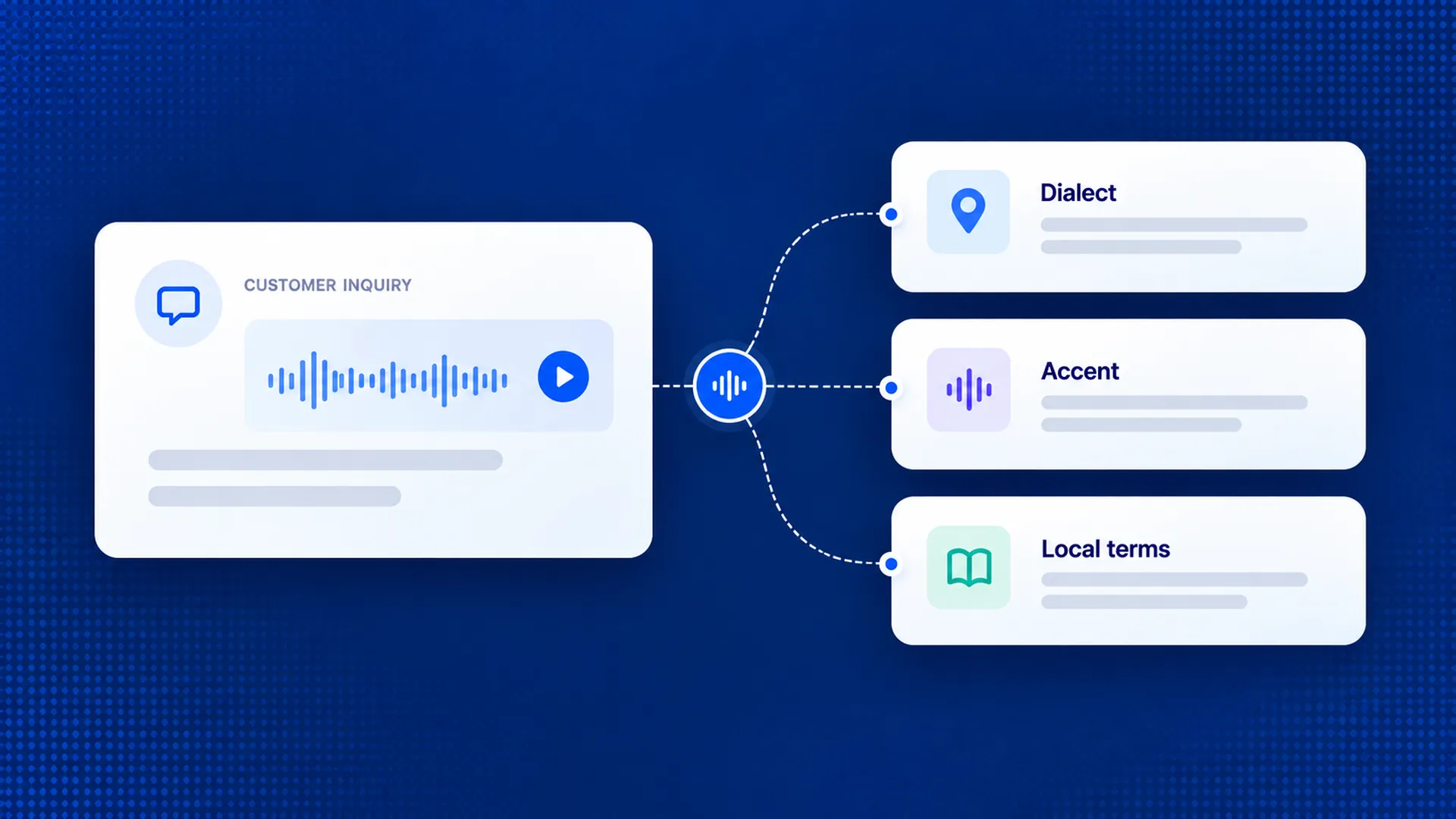
A caller might say, “هلا، لقيت البطاقة في مكان ثاني وأنا محتاج أرجع أشغلها، كيف أقدر أسوي كذا؟” They have found their card and want to use it again. The agent needs to understand that they are asking about reactivation, then follow the bank's verification and service procedures. Instructions for replacing a lost card would take the conversation in the wrong direction.
The same care applies to the reply. Word choice and grammatical agreement shape how a response sounds, and the right degree of formality may differ between a public information line and a customer service conversation. The language needs to fit the audience and the work.
Local conversation design for customer requests
In the renewal call at the start of this article, a customer who asks to be called next week has not accepted the offer. The useful outcome is a follow-up request with the right context. If the customer has a question about the terms, the conversation needs an accurate answer or a route to someone who can help. Those are different outcomes, even when both calls end politely.
Customers also pause, interrupt and correct themselves. A pause does not always mean the person has finished; a correction may change the request entirely. If a date or requested action is unclear, a focused confirmation lets the customer correct that detail without repeating the whole story. The service should carry the corrected information into the next response and any follow-up, rather than act on the first interpretation.
When we design these flows with our clients, our local conversation specialists focus on the operational logic behind every turn: how the agent introduces information, answers predictable questions, and responds when a customer changes direction. The goal is to make the next step clear to both the customer and the team.
For a service leader, the difference shows up after the call: is the next team working from the customer's actual request, or correcting a category that never described it? For a sales leader, the same distinction affects whether follow-up reaches someone who is interested, undecided or has declined.
A Saudi Arabic voice built for business
Names, local landmarks and financial terms need to be clear when spoken aloud. Dyna.Ai's Saudi Arabic TTS engine supports Arabic–English mixed text and pronunciation dictionaries for local names, places and industry terms. That gives teams a way to guide how important words are spoken.
The engine's text normalization is built to interpret Hijri dates, complex numeric expressions, and special symbols before rendering speech. It also supports explicit Tashkeel, the marks that guide Arabic pronunciation. A date or name may appear unambiguous on a screen yet be difficult to understand when read aloud; these controls give the team a way to refine how it is spoken.
Dyna.Ai's Saudi Arabic TTS engine recorded a 3.77% character error rate on complex text, a 4.040 MOS naturalness score, and a 0.5375 speaker similarity score. These figures relate to the voice engine. The customer experience also depends on the conversation, the information available and what happens after the response.
From voice technology to business outcomes
A voice engine speaks the words. A voice agent must interpret what the customer needs and move the business process forward. Our Dyna.Ai Voice Agent brings those capabilities into configured service, sales, and follow-up workflows.
Return to the renewal call. The agent explains the offer, listens to the customer's response and answers the questions it is configured to handle. If the customer asks for more time, the next step is a follow-up, not a completed renewal. If a specialist is needed, the employee should receive the relevant request and what has already been discussed, within the permissions of the service.
Our local delivery teams work with customers to fit these workflows into their existing environment. A general inquiry, an account-specific request and a handoff to a specialist each require different information and handling.
The distinction matters when measuring results. For a renewal campaign, calls placed show outreach activity; interest, agreed follow-up and completed renewal describe different stages of progress. For a service line, the question may be whether the customer reached the right team or received a useful answer. Looking at those outcomes alongside the calls helps a team improve the conversation, not just increase its volume.
AI in Saudi service operations
To see how this works in practice, consider two distinct deployments in the Kingdom:
A Saudi bank uses Dyna.Ai's conversational AI to improve its customer service routing. Customers can describe what they need instead of navigating multi-level keypad menus. The system considers the request, language preference and location before routing the call, reducing manual routing work for the service team.
A Saudi public-sector roads authority uses Dyna.Ai's Arabic Customer Service Copilot to bring relevant guidance to employees during citizen hotline calls about road-related requests. Automated quality assurance reviews completed interactions, giving supervisors a broader view of service consistency. The Copilot supports the employee during the conversation; the quality workflow helps supervisors review what happened afterward.
The bank and the authority use AI for different parts of their operations. In both cases, the value comes from connecting language capabilities to a specific service need.
Local delivery, deployment and data protection
For a bank or government agency in the region, choosing a voice model is only the first step. Customer interactions involve sensitive personal data, financial records, and confidential service requests. Leadership teams rightly demand absolute clarity on where data is processed, where transcripts and recordings are stored, who holds access privileges, and how long records are retained.
Local delivery teams can work with the customer's IT and compliance teams on these requirements. Dyna.Ai supports enterprise deployment models, including private or on-premise configurations where required and approved. Security controls and data processing locations depend on the deployment and are agreed with the customer.
Language design, system integration and data requirements all shape the service that customers eventually experience.
What to look for in an Arabic voice AI partner
When evaluating an Arabic voice service, listen beyond the greeting. Can the agent follow a customer who changes their mind? Does it pronounce the terms your customers use? What happens when someone interrupts or asks for a person?
It is also useful to understand who designs the conversations, how the service connects to the work of your teams, and how you will measure the outcome. The answers matter as much as the voice itself.
Make Arabic conversations count
Dyna.Ai combines Saudi Arabic voice technology with local conversation design and delivery. Together, they help teams create conversations that customers can follow and employees can act on.
Explore Dyna.Ai Voice Agent to see how we can support your customer service, sales, and follow-up operations.