

Artificial Intelligence has become a central pillar of digital transformation strategies across the global banking industry. From credit scoring and fraud detection to customer engagement and investment advisory, financial institutions are investing heavily in machine learning models and data platforms to improve decision-making.
Yet despite these investments, many Artificial Intelligence initiatives struggle to deliver measurable business outcomes.
The challenge rarely lies in the technology itself. Modern Artificial Intelligence systems are capable of analyzing vast datasets, identifying patterns, and producing highly accurate predictions. Instead, the difficulty lies in translating these insights into operational decisions that generate real financial impact.
In many organizations, Artificial Intelligence models reach production environments but remain underutilized by the very teams they were designed to support.
The result is a common but overlooked problem. Artificial Intelligence systems may be technically successful, yet commercially ineffective.
Understanding the gap between model deployment and real-world adoption is therefore critical for banks seeking to transform Artificial Intelligence investments into measurable revenue outcomes.
These challenges are explored in greater depth in the whitepaper From Pilots to Production: How Banks Turn Artificial Intelligence into Revenue, which examines how financial institutions move beyond experimentation and operationalize Artificial Intelligence across the organization.
[Download this whitepaper to get exclusive insight]
The Gap Between Deployment and Adoption
Many Artificial Intelligence initiatives follow a familiar trajectory.
A data science team develops a model intended to improve decision-making in areas such as lending, fraud prevention, or customer engagement. The system performs well in testing environments and eventually moves into production deployment.
At this stage, the project is often considered a success.
However, technical deployment does not necessarily mean the system is actively shaping business outcomes.
Frontline teams such as credit analysts, relationship managers, and customer service representatives must incorporate these insights into their daily workflows. Without this integration, Artificial Intelligence remains an analytical tool rather than a decision-making engine.
This disconnect between model deployment and operational usage represents one of the most significant barriers to achieving measurable value from Artificial Intelligence initiatives.
Why Adoption Matters More Than Model Accuracy
Artificial Intelligence development often prioritizes technical performance metrics such as prediction accuracy, model precision, or processing efficiency.
While these indicators are important, they do not determine whether Artificial Intelligence delivers real business value.
Revenue impact depends on whether Artificial Intelligence insights influence the decisions that shape customer interactions, lending approvals, and investment strategies.
For example:
- A credit scoring model may produce more accurate risk predictions.
- A recommendation engine may identify promising cross-selling opportunities.
- A fraud detection system may identify suspicious transactions faster.
- Yet if frontline teams do not actively rely on these systems, their potential remains unrealized.
- Successful Artificial Intelligence initiatives therefore depend not only on technological innovation, but also on organizational adoption. Systems must be trusted, understood, and embedded into everyday workflows.
- When Artificial Intelligence becomes part of the operational fabric of an institution, its impact moves beyond analytics and begins to influence revenue-generating activities.
Case Study: BBVA Mexico’s “Next Best Action” Platform
A practical example of this principle can be seen in BBVA Mexico’s implementation of its “Next Best Action” platform.
The system uses Artificial Intelligence models to analyze customer data and generate personalized product recommendations in real time. These recommendations are delivered directly to relationship managers and digital banking channels, enabling frontline teams to identify relevant offers during customer interactions.
Rather than operating as a separate analytics tool, the system integrates directly into the workflows used by sales and advisory teams.
This integration is critical.
Relationship managers can act on Artificial Intelligence insights while engaging with customers, enabling more targeted conversations and relevant product recommendations.
By embedding data-driven insights into everyday interactions, BBVA Mexico has been able to significantly improve conversion rates for banking products and services.
The case illustrates a key insight highlighted throughout the whitepaper. Artificial Intelligence generates measurable value when it becomes embedded in frontline decision-making rather than remaining confined to analytical environments.
Bridging the Trust Gap
Adoption ultimately depends on trust.
Banking professionals are responsible for high-stakes decisions involving credit approvals, investment portfolios, and financial risk management. As a result, they must have confidence in the systems supporting their work.
Artificial Intelligence models that operate as opaque “black boxes” can create hesitation among employees who do not understand how recommendations are generated.
To address this challenge, institutions must design systems that emphasize transparency and explainability.
When users understand how data inputs influence model outputs, they are more likely to rely on Artificial Intelligence insights in real decision-making scenarios.
Equally important is ensuring that Artificial Intelligence tools complement existing workflows rather than disrupt them.
Systems that integrate seamlessly into familiar operational interfaces are far more likely to be adopted consistently by frontline teams.
Visualizing the Adoption Gap
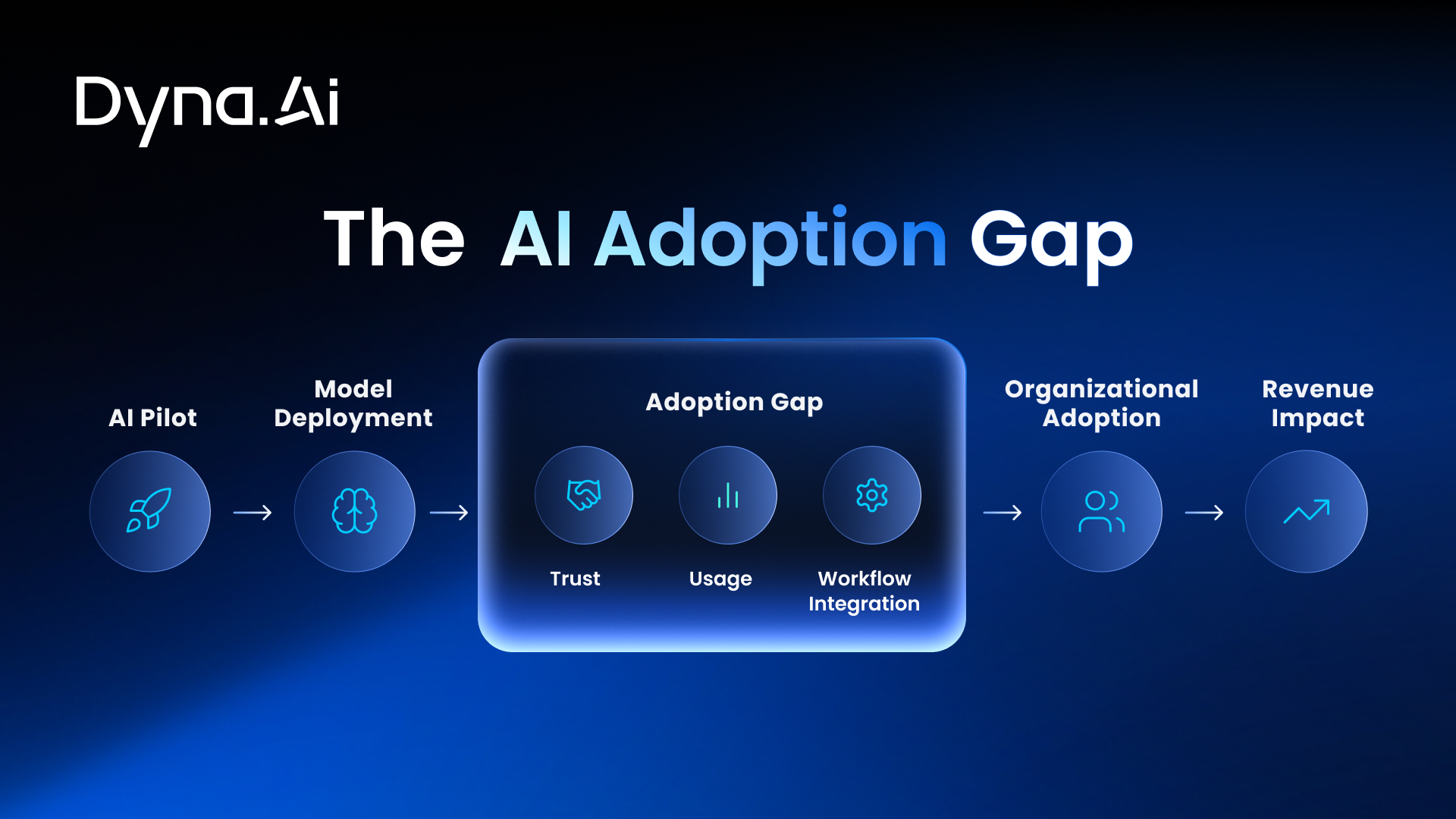
This visual illustrates the gap that often emerges between the technical deployment of Artificial Intelligence systems and their full operational adoption.
While machine learning models can be developed and deployed relatively quickly, organizational trust and workflow integration take longer to build. Bridging this gap is essential for ensuring that Artificial Intelligence initiatives generate measurable business impact.
Institutions that focus solely on technical development risk leaving valuable capabilities underutilized. Those that prioritize adoption alongside innovation are far more likely to realize the commercial potential of Artificial Intelligence.
From Artificial Intelligence Tools to Revenue Engines
Banks that successfully translate Artificial Intelligence into revenue share a common approach.
Rather than treating models as experimental tools, they embed Artificial Intelligence insights directly into operational processes that influence customer engagement, credit decisions, and investment strategies.
Over time, this integration creates a compounding effect.
Each successful implementation strengthens the institution’s ability to deploy additional Artificial Intelligence capabilities across new functions and business units.
What begins as a single analytical model gradually evolves into a network of data-driven systems supporting decision-making across the organization.
In this way, Artificial Intelligence becomes more than a technological advancement. It becomes a core driver of competitive advantage.
Explore the Full Research
These insights are explored further in the whitepaper From Pilots to Production: How Banks Turn Artificial Intelligence into Revenue.
The report examines how financial institutions move beyond pilot initiatives and build scalable Artificial Intelligence capabilities that deliver measurable business outcomes.
[Download this whitepaper to get exclusive insight]